

I’ve tried many different kindergarten writing programs over the years and have enjoyed some components of each. The problem with many of them, though, is the pacing. I want to share with you how I structured my lessons to create effective stages for a kindergarten writing workshop.
As I’ve mentioned before, my classes were mostly comprised of English learners. Usually, a quarter of my students couldn’t speak any English at the beginning of the year. Obviously, with this kind of classroom makeup, you need to differentiate your instruction, but even native English speakers need a good deal of scaffolding to be successful writers.
When you look at the Common Core kindergarten writing standards, it’s easy to get overwhelmed! Some students come in with zero letter knowledge, and then by the end of the year, they’re supposed to be writing an opinion piece?!?!
Here’s how I took things step by step in my classroom to bridge that enormous leap in learning.
Writing Workshop Stage 1: Letter Practice
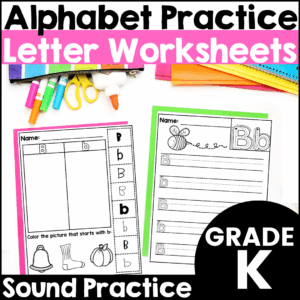
Stage 1 begins with letter practice. For my mini-lesson, I go over how to form individual letters, both uppercase and lowercase. Students then have independent practice time forming the letters.
You can use printed copies of practice pages if you want, but I personally was not allotted very many copies for my class. I bought this paper at the beginning of the year and have used it daily. I had them alternate lines between upper and lowercase.
I taught 4 letters each week, and on Friday, we reviewed and practiced the 4 we’d learned. One letter per line.
The time it takes each student to complete this page of letters can vary. For my early finishers during this time block, I always have fine-motor activities ready for them. Here are some examples of fine motor activities that help strengthen hand muscles:
- Lacing cards (Make sure they unlace the card when time is up to avoid a mess later)
- Tracing practice
- Maze task cards
- Hole punch activities
- Cutting strips of paper
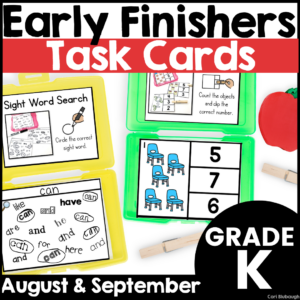
- Clothespin activities (Check out my early finisher activities)
Check out this blog post for a list of my favorite fine motor tools, along with a freebie fine motor activity. You might also like this letter formation rubric to help you assess each student’s progress and communicate strengths and needs to parents.
I usually set aside 30-45 minutes for my writing block every day. By the end of the first 2 months, I’m ready to move on to the next stage in our writing workshop.
Writing Workshop Stage 2: Word and Sentence Mechanics
At this point in our writing journey, I add in writing journals so that I can see the progress of the students through the end of the year. I teach them how to write the date on each paper so I can reference their growth later.
A lot of time is spent teaching the students how to turn one page at a time. I got the idea to glue a ribbon to the books so they can quickly flip to the correct page from The Happy Teacher’s Palette, and it worked really well!

Mini-lessons in stage 2 include the following topics:
- Finger spacing
- The difference between an uppercase and lowercase letter, and when to use them
- Letter-size
- The difference between spacing letters in a word and the spacing between words.
- Beginning, medial, and ending sound isolation and recognition.
- Shared writing
If you’d like a free list of 70 writing mini-lessons, check out this post and grab the freebie!
In your phonics lessons and during center time, you should already be doing a lot of work on phoneme isolation, so writing time is just a review of these concepts.
I give the students sentences that they need to copy into their journals, and the steps of that look something like this:
- Step 1 – Copy from the board – I see a dog.
- Step 2 – I see a ______. (Provide a picture of a dog and they sound it out).
- Step 3 – I ____ a ______. (Have them write the word see and dog independently.)
- Step 4 – Complete independent writing of the dictated sentence.
- Step 5 – Finish the sentence – My favorite pet is ________.
(I also have additional dictation practice once a week to help them practice this skill.)
We write 3-4 sentences a day together to practice our spacing, letter size, sight-word knowledge, and letter-sound knowledge. You can provide students with letter charts if needed.
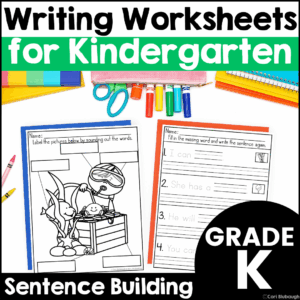
After we practice sentences together, I have them complete an independent worksheet from my beginning writers resource. I created this resource when I had a super low group of writers one year. They needed a lot of scaffolding and baby steps to get started with the writing process.
The time I spend at this stage of the writing workshop varies the most from year to year. Some classes need a lot of extra guided practice, and some are ready to jump right into the deep end and begin writing their own stories. Be flexible; it’s okay to change things around from year to year.
Writing Workshop Stage 3: Independent Writing
During this writing workshop stage, students really get to showcase all they’ve learned. I like to start out with a writing prompt, kind of piggybacking on the last stage of dictated sentences. I’ll ask them, for example, what their favorite dessert is, and they need to write: “My favorite dessert is _________ because ________.” We work on expanding sentences and focusing on one topic.
Writing Confidence
Students can struggle as they move into the third stage with their writing confidence. It’s scary to take the training wheels off and write all on your own. Here are some tips and tricks I’ve learned over the years to help build students’ confidence.
Classroom Environment
I’m not a stickler for a quiet class, but my exception to that is during writing time. I like to create a quiet, peaceful environment.
I dim the lights and have classical music or the Calm app playing. We do several mini-lessons about my behavior expectations, including the following:
- What to do when you don’t know how to spell a word (that doesn’t include talking to a friend or asking a teacher).
- How to start a new story if you’ve finished the assignment for the day.
- What to do if your pencil breaks.
- How to write the entire writing workshop time continuously.
- Where it’s acceptable to work on your writing. (I’m a big believer in flexible seating and letting students sit where they are comfortable and productive.)
- How to add more detail to your picture.
- How to add more sentences to your story.
Student Conferences
Setting my behavior expectations first and working on student stamina are super important during this stage, so I can conduct student conferences.
I try to do 3-4 every day. The student shares their writing with me, and I give them a few tips or suggestions to help them grow.
It’s imperative that the students know this isn’t a time to interrupt and that they need to resolve any issues independently.
Writing Genres
This stage is when I deep dive into the writing genres, and we work on them one at a time. I usually start with opinion pieces, then move to narrative, explanatory, and lastly research.
Sharing
I also try to incorporate sharing time into this stage. Once students see their peers’ work, they get super motivated and really look forward to their sharing time. I really feel like I get higher-quality work from them when they know they’ll be sharing.
Do you structure your writing workshop time differently? Let me know if you have any comments on how you structure yours!