Every year, I start making my list of end-of-the-year kindergarten assessments and have the same reaction: Wow, we covered a lot this year!
When you stop and think about everything kindergarten students learn between August and May, it is truly incredible. At the beginning of the year, many students are still learning to recognize letters and understand classroom routines. By the end of the year, they are reading simple texts, solving math problems, writing sentences, and demonstrating a wide range of foundational skills that will prepare them for first grade.
Because there are so many skills to assess, it can feel overwhelming to decide what to prioritize. While every district and school may have different requirements, I like to focus on the foundational skills that give me the clearest picture of a student’s readiness for the next grade level.
I begin the year with my beginning-of-year assessments to get a baseline of where everyone is starting.
End-of-Year Language Arts Assessments
Language arts growth is often one of the most noticeable areas of development during kindergarten. Students go from learning individual letters and sounds to using those skills to read and write words.
Some of the language arts skills I added to my kindergarten assessments at the end of the year include:
Letter Name Recognition
Students should be able to quickly identify both uppercase and lowercase letters. This skill provides the foundation for all future reading and writing development.
Letter Sound Recognition
Knowing letter names is important, but students also need to connect letters with the sounds they represent. Strong letter-sound knowledge supports decoding and early reading success.
CVC Words
CVC (consonant-vowel-consonant) words help determine whether students can blend sounds together to read simple words independently.
CVCE Words
Assessing CVCE words allows you to see whether students are beginning to understand long vowel patterns and apply their phonics knowledge to more advanced words.
Beginning Blends
Beginning blends can be challenging for young readers. Assessing this skill helps identify students who are ready for more complex phonics instruction.
Digraphs
Students should be able to recognize and read common digraphs such as sh, ch, th, and wh.
Sight Words
Sight word recognition helps build reading fluency and confidence. End-of-year assessments can help determine which words students have mastered and which may need additional review.
Rhyming Words
Rhyming remains an important phonological awareness skill and provides insight into students’ understanding of word patterns and sounds.
Syllables
Clapping, counting, and identifying syllables demonstrates students’ awareness of the sound structure of words, an important pre-reading skill.
End-of-Year Math Kindergarten Assessments
Kindergarten math skills grow just as dramatically throughout the year. Students move from basic counting to solving simple equations and understanding number relationships.
Here are the math skills I focus on assessing at the end of the year:
Number Recognition
Students should be able to identify numbers quickly and accurately.
Counting and One-to-One Correspondence
This assessment helps determine whether students understand that each object counted represents one number in a sequence.
Teen Number Recognition
Teen numbers can be tricky for young learners. Assessing this skill helps ensure students understand numbers beyond ten and are ready for first-grade math concepts.
Counting On
Rather than starting at one each time, students learn to begin with a given number and continue counting from there. This is an important strategy for developing number sense.
Number Comparison
Comparing numbers helps students understand concepts such as greater than, less than, and equal to.
Addition and Subtraction Fluency Within 5
Students should be able to solve basic addition and subtraction problems with confidence and increasing fluency.
Making 10
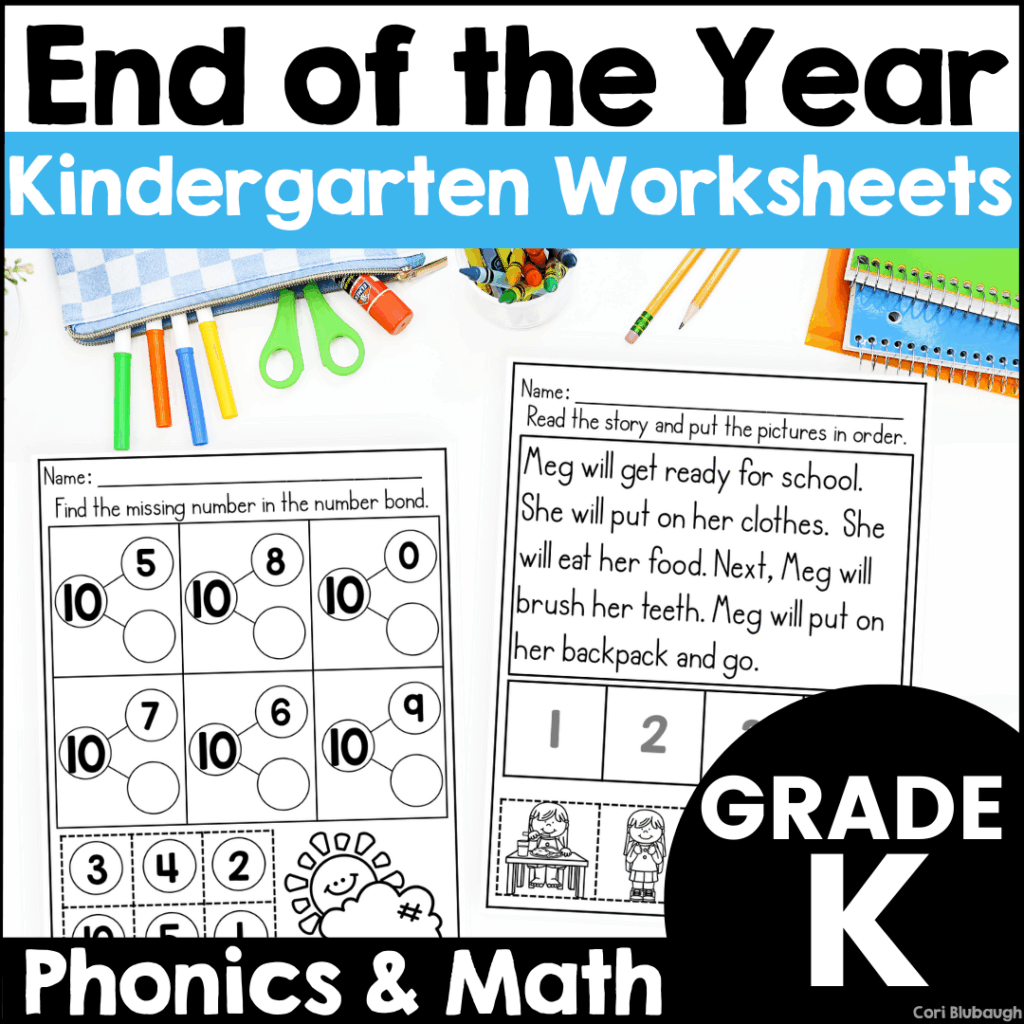
The ability to compose and decompose numbers to make ten is a key foundational skill that supports future mental math strategies.
Making an Equation
Students demonstrate their understanding of mathematical relationships by creating equations to represent addition and subtraction situations.
2D and 3D Shapes
Students should be able to identify and describe common two-dimensional and three-dimensional shapes.
Different Ways to Use End-of-Year Kindergarten Assessments
One of the things I love about digital kindergarten assessments is their flexibility. They can be used in a variety of ways depending on your classroom needs.
One-on-One Assessment
Sit with individual students as they complete the assessment and record observations. This approach allows you to gather additional information about student thinking and problem-solving strategies.
Independent Assessment
Allow students to complete the assessments independently. This can provide a quick snapshot of overall mastery and help identify students who may need additional support.
Small Group Assessment
Use the assessments with small groups of students who need targeted progress monitoring or intervention.
Progress Monitoring
Even after completing end-of-year testing, these kindergarten assessments can remain valuable tools for monitoring growth and identifying areas that may need review.
Making the Most of Your Kindergarten Assessment Resources
Assessment tools require significant preparation and planning, so it’s always helpful when they can serve multiple purposes. After completing your end-of-year assessments, the same activities can often be used for center rotations, independent practice, review sessions, intervention groups, or even summer skill reinforcement.
The goal of end-of-year assessments isn’t simply to collect data. It’s an opportunity to celebrate the incredible growth your students have made throughout the year while identifying any final skills that may need support before first grade.
When you look back at where your students started and compare it to where they are now, it’s amazing to see just how much learning happens during a kindergarten year.
If you are interested in this end-of-the-year Boom Card assessment bundle, you can find it in 2 places:
- Boom Learning Platform – Kindergarten End-of-Year Assessments
- TPT – Kindergarten End of the Year Assessments
Here are some other end-of-the-year resources to help you finish the year strong!